✍️By Dr. Ashma Begum
What if the most important climate-finance reform is not another financing instrument, but changing what we count as a “good” development outcome?
This question is at the heart of a live, and increasingly urgent, debate around the World Bank’s climate-finance approach. For years, we have been obsessed with a binary: Is this climate finance or development finance? How much of a project is “climate”? How do we tag it, track it, and count it?
But that distinction may be the very thing holding us back.

A water-security project in Chennai, for example, can simultaneously be climate adaptation, public-health infrastructure, urban resilience and economic development. India and ADB signed a $230 million agreement on 21 August 2026 for precisely such a climate-resilient water and sewerage project. It is not just a pipe-and-pump project. It is a health project, a gender project, an urban productivity project.
This suggests a deeper proposition:
Perhaps the strongest climate-finance projects are those where “climate” is not the endpoint, but the lens through which development investment is redesigned.
Why the Greens and Hills of the Northeast are a Climate System, Not Just Scenery
Nowhere is this proposition more visible than in North East India.
The North East — Assam, Arunachal, Meghalaya, Nagaland, Manipur, Mizoram, Tripura, Sikkim — is often described as India’s climate hotspot and its ecological hope at the same time.
It holds 7% of India’s landmass but nearly 25% of its forest cover, 1/4th of India’s biodiversity hotspot, and acts as the country’s eastern carbon sink. Its greens are not just greens. They are climate infrastructure.
1. The Hills as Climate Regulators: The hills of Meghalaya, Nagaland and Arunachal force monsoon clouds to rise, cool and rain — the orographic effect that creates Mawsynram and Cherrapunji. When we deforest the hills for jhum shortening or unplanned road cutting on NH-13/NH-15, we don’t just lose trees, we alter rainfall patterns for the entire Brahmaputra valley downstream.
2. The Himalayan Effect — The Third Pole is Unravelling Above Us: The Eastern Himalayas above Arunachal and Sikkim are warming 2-3x faster than the global average. What happens there doesn’t stay there:
- Glaciers feeding the Siang/Dibang/Lohit are receding — altering the timing of water availability. More water in May-June, less in Feb-March.
- Glacial lakes are forming above Tawang — 28 high-risk lakes in Arunachal alone. A GLOF event becomes a flood in Dhemaji and Dibrugarh within hours.
- The loss of snow cover changes albedo, heats the hills further, and dries up the springs that Meghalaya and Arunachal villages depended on for centuries. In Seppa, East Kameng, women now walk longer every winter.
3. Forests as Water Towers: The Zabo system of Nagaland, the bamboo drip irrigation of Meghalaya, the sacred groves of Meghalaya and Arunachal — these are not traditions, they are engineered systems where forest = water storage. One hectare of intact hill forest can hold 3,000-5,000 litres more water than degraded land. When we fund a forest, we are funding a reservoir.
Climate change is not a future projection.
Too much and too little water: Same district in Assam faces devastating floods in June-July and acute drinking water scarcity by February-March. Springs in Meghalaya and Arunachal are drying.
From Jhum to Uncertainty: Shifting cultivation cycles shortened, rainfall erratic, landslides more frequent, unseasonal hailstorms destroying large cardamom, kiwi, orange.
The hidden health cost: Floods bring water-borne diseases. Drying springs force unsafe sources. Heat stress now in traditionally cool hill towns like Shillong and Kohima.
The Real Test for Climate Finance
If we fund a “climate project” in the North East as a siloed category, we will fail. What the region needs is Climate-resilient development.
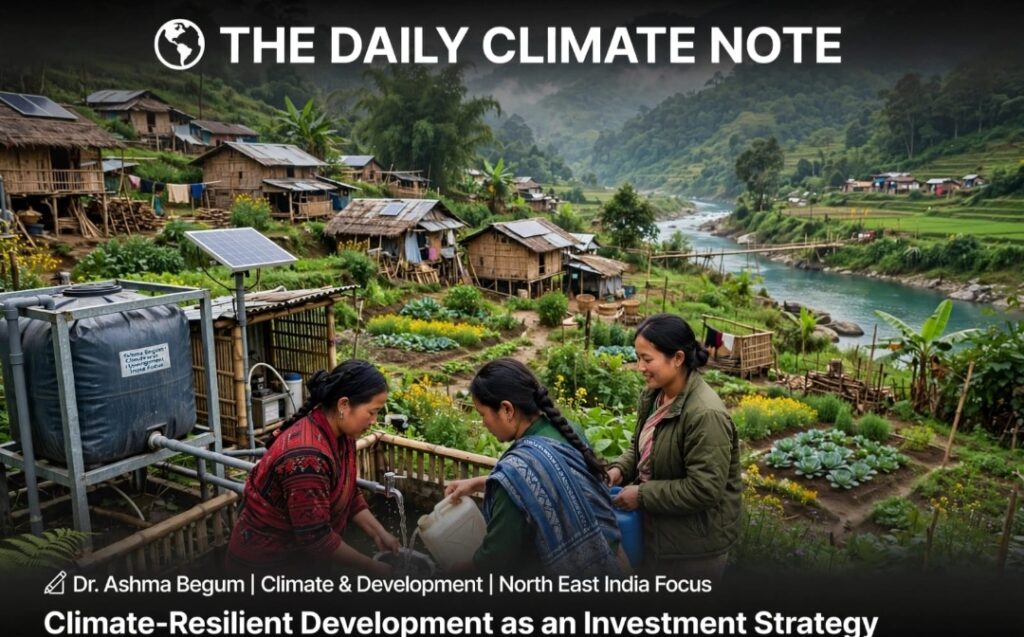
A rainwater harvesting tank with solar pumping in Arunachal is not just adaptation. It is:
- A public health intervention (safe drinking water)
- A gender justice intervention (reducing drudgery for women)
- A livelihood intervention (water for winter vegetables)
- A green infrastructure intervention (reducing pressure on springs and forests)
Similarly, a flood-resilient school in Majuli is education continuity + disaster risk reduction + economic resilience.
The real test, therefore, is not:
“How much money did we label as climate finance?”
But rather:
“Did the financing reduce climate risk while improving the underlying development system — its water, its greens, its hills?”
That single shift moves the conversation from climate finance as a category to climate-resilient development as an investment strategy.
For World Bank, ADB, and state governments, this means three changes:
1. Count outcomes, not just inputs: Measure reduction in water insecurity days, spring rejuvenation, forest water retention — not just dollars spent.
2. Design for co-benefits from day one: Every road, school, health centre, and water scheme in the North East should be screened through a Himalayan-hills-green lens by default.
3. Value local knowledge as climate technology: The Zabo, the bamboo drip, the Apatani paddy-cum-fish system — these are centuries-old climate-resilient models. Finance should scale them, not replace them.
The Chennai agreement is a signal. The next frontier is to apply that same integrated logic to Seppa and Tawang, to Cherapunji and Kohima, to Majuli and Aizawl.
Because in the North East, we have always known: you cannot separate the river from the village, or the forest from the farm, the hill from the cloud, or the glacier from the green.
It’s time our finance learned the same.
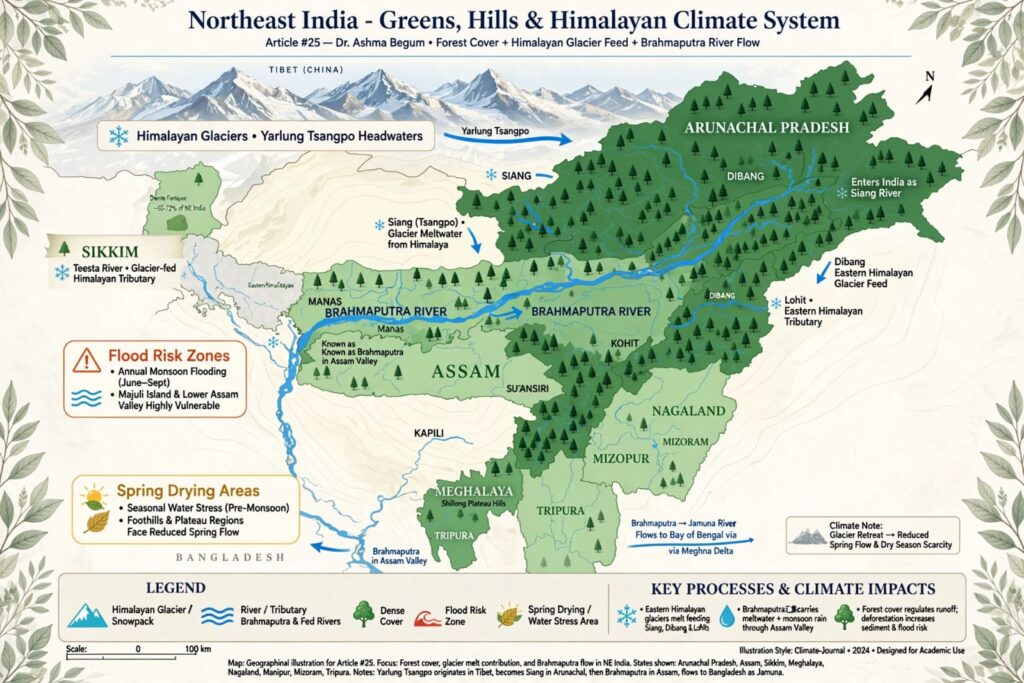
–( – Greens, Hills & Himalayan Climate System ,_”Why the Greens and Hills…”)
- Top – Himalayan Glacier Feed: Yarlung Tsangpo → Siang/Dibang/Lohit entering Arunachal
- Middle – Forest as Climate Infrastructure: Dense forest cover over Arunachal, Sikkim, Meghalaya hills
- Center – Brahmaputra Flow: The blue artery carrying glacier melt + monsoon through Assam valley to Bangladesh
- Left boxes: Flood Risk Zones (Majuli, Lower Assam) + Spring Drying Areas — the “too much and too little water
Climate & Development | North East India Focus
#DailyClimateNote #ClimateFinance #NorthEastIndia #HimalayanGLOF #GreenInfrastructure #ArunachalPradesh #Assam #WaterSecurity #WorldBank #ADB
About the Author